Blogia

La Bitácora del Dr. Ucha

Body Type and Performance of Elite Cuban Baseball Players

Wiliam Juan Carvajal, MS, Andrs Ros, MD, Ivis Echevarra, Miriam Martnez, Julio Mioso, MD, Dialvis Rodrguez, MS

MEDICC Review » Spring 2009, Vol 11, No 2 » Research & Practice

Introduction Appropriate stature and adequate somatotype are not the only attributes determining athletic performance, but they are important prerequisites for sports participation and success. However, there is scant literature on baseball players’ kinanthropometric profiles and their association with performance. Given that Cuban baseball players have been among the world’s top performers in recent decades, characterization of their morphological features linked to their performance may contribute to developing the evidence base in this area.

Objective Describe the kinanthropometric profile related to sports performance of elite Cuban baseball players, classified by playing position.

Methods Body composition, somatotype, proportionality, and performance were measured in 100 elite baseball players grouped by playing position and performance. Data from the 2002–2003 baseball season was gathered for players participating in the 43rd Cuban National Baseball Series (November 2003–May 2004). Slugging percentage (SLG) was used to measure performance of all players except pitchers, whose performance was measured as end-of-season win-loss record. Mean and standard deviation values were calculated for anthropometric and performance results, presented in tables for comparison. ANOVA and MANOVA analyses were applied to determine magnitudes of difference between the variables studied, as well as statistical significance of the differences established (p≤0.05 and p≤0.01).

Results Performance and body type varied by playing position, and statistically significant differences were found in performance, body composition and somatotype variables between some positions. No significant differences in proportionality were found. First basemen and outfielders (center, left, and right fielders) were the best offensive players with the highest mean SLG, body weight and muscle mass values. Infielders (second basemen, shortstops, and third basemen) had the lowest mean body weight and adipose tissue mass values, as well as the lowest mean SLG. Catchers had similar mean weight, height, muscle mass, and adipose tissue mass values as first basemen, outfielders and infielders, but a low mean SLG similar to that of infielders. Pitchers were morphologically similar to players in all positions, but significant morphological differences were found among pitchers with different performance levels. Better-performing pitchers (≥.600 winning percentage (Wpct)) were significantly heavier and more mesomorphic than lower-performing pitchers (<.600 Wpct). All players were predominantly mesoendomorphic, but mean somatotype values varied between players in different positions, and between pitchers with different performance levels.

Conclusions The kinanthropometric profile of high-performance baseball players described in this study generally coincides with the available literature. Further research on comparative samples is needed to validate the relationship between players’ body type and performance. Nevertheless, the results of this study may be applied to criteria for selection and training of high-performance baseball players in Cuba.

Kinanthropometric Profile of Cuban Women Olympic Volleyball Champions

Wiliam Carvajal MS, Hamlet Betancourt PhD, Sofia León PhD, Yanel Deturnel MS, Miriam Martínez, Ivis Echevarría, María Eugenia Castillo, Noemí Serviat MD MS

MEDICC Review » April 2012, Vol 14, No 2 » Original Research

Abstract

INTRODUCTION Athletes' kinanthropometric profiles are widely addressed in the scientific literature. Such profiles are particularly important in volleyball because absolute size contributes a significant percentage of total variance associated with athletic success. As in other team sports, volleyball players' kinanthropometric attributes correlate with the game's tactical demands. From 1992 through 2000, the Cuban women's volleyball team achieved top global performance, winning first place in three successive Summer Olympic Games.

OBJECTIVE Describe the kinanthropometric profiles of Cuban women Olympic volleyball champions during 1992–2000 and compare these by position played.

METHODS Measurements were taken of body composition, somatotype, proportionality and several anthropometric indicators in 41 Cuban women volleyball players, grouped by playing position. All were members of the national team that participated in the Summer Olympic Games in Barcelona (1992), Atlanta (1996) and Sydney (2000). Mean and standard deviations were calculated for all study variables. Analysis of variance was used to compare means for different positions for the variables weight; height; percent adipose, muscle and bone mass; body mass index; and muscle-to-bone ratio. Discriminant analysis was performed to identify anthropometric dimensions differentiating playing positions (center, spiker and setter), using p<0.05 as significance threshold. Results were presented in tables and figures.

RESULTS Centers presented greater absolute size and higher average adipose (22.8±1.7 kg) and bone (7.1±0.6 kg) mass. The mean somatotype of all volleyball players was balanced mesomorphic (2.7–3.6–2.9). Classified by position, centers (2.9–3.4–3.4) and spikers (2.8–3.6–2.9) presented an average mesomorphic–ectomorphic somatotype, and setters (2.6–3.7–2.6) were balanced mesomorphic. On assessing Somatotype Attitudinal Mean (SAM), centers and spikers showed more intrapositional homogeneity than that of setters. Centers were significantly taller (187.1±2.5 cm) than players in other positions. Centers' percent adipose tissue mass (28.9±2.7%) was significantly higher than that of setters (24.3±2.7%), who were leanest of all positions.

CONCLUSIONS The kinanthropometric profile of Cuban women Olympic volleyball champions was defined by considerable muscular-skeletal development, with a predominantly mesomorphic somatotype and low endomorphy. Height and body composition varied significantly by playing position.

Medicc Review Ahora en línea - El número de Abril 2012

Gender and Health in Cuba

TEMAS:

Perspectiva de género en el sistema de salud cubano

Entrevista con Mariela Castro, directora, Centro Nacional de Educación Sexual

Derecho a la atención en salud para personas transexuales

También:

Testimonio de una cubana con cáncer de mama

Perfil hormonal de la mujer menopáusica en La Habana

Perfil cineantropométrico de cubanas campeonas olímpicas de voleibol

La epidemia cubana de dengue hemorrágico en 1981 (reprint)

Table of Contents April 2012 (Vol. 14, No 2)

Editorial

Gender & Health: Towards a Consensus on Rights, Policy and Public Opinion

Interview

Revolutionizing Gender: Mariela Castro MS
Director, National Sex Education Center

Gail Reed MS

Special Article

Speaking from Experience: Today’s Cuban Women and Breast Cancer

Marta Núñez MS PhD

Original Research

Hormone Profile of Menopausal Women in Havana

Daysi Navarro MD PhD, et al.

Kinanthropometric Profile of Cuban Women Volleyball Champions

William Carvajal MS, et al.

Cross-Modal Plasticity in Cuban Visually-Impaired Child Cochlear Implant Candidates:
Topography of Somatosensory Evoked Potentials

Lidia E. Charroó-Ruíz MD MS, et al.

Lessons from the Field

Perspective

The  Right to Health Care for Transsexual People in Cuba

Alberto Roque MD and R. Mayra Rodríguez MS

Incorporating a Gender Perspective into Cuba’s Health System:
Realities and Challenges

C. Leticia Artiles MS PhD

Abstracts

Cuban Research in Current International Journals

Reprint

Thirty Years after the Cuban Hemorrhagic Dengue Epidemic of 1981

María G. Guzmán MD PhD DrSc

Viewpoint

High Time: Cuban TV Serials Spur Debate on Sensitive Social Issues

Dixie E. Trinquete MS

About the Contributors

Learn more about the Contributors

Una revista arbitrada de libre acceso 

MEDICC Review (ISSN 1527-3172, en línea), es una revista trimestral publicada en idioma inglés por MEDICC (Medical Education


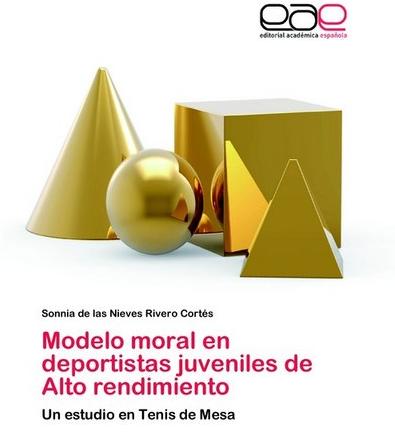
Modelo moral en deportistas juveniles de Alto rendimiento

Modelo moral en deportistas juveniles de Alto rendimiento

Un estudio en Tenis de Mesa

Por Sonnia de las Nieves Rivero Cortés

https://www.morebooks.de/store/es/book/modelo-moral-en-deportistas-juveniles-de-alto-rendimiento/isbn/978-3-8473-6970-7

Editorial Académica Española (2012-03-26)

Principio del formulario

Final del formulario

ISBN-13: 978-3-8473-6970-7

ISBN-10: 3847369709

EAN: 9783847369707

Idioma del libro:

Notas y citas / Texto breve:

El presente trabajo trata de un acercamiento al tema de los valores morales en el contexto de los equipos juveniles de Alto Rendimiento Deportivo. Nuestros objetivos fundamentales están dirigidos a: - Conocer el modelo moral y las cualidades morales, funciones de la moral y escala de valores en los deportistas estudiados, y - Describir las cualidades morales positivas y negativas, individuales y colectivas, conocimientos y experiencias personales o transmitidas por la familia, escuela o grupo social en este grupo. Para ello seleccionamos varios temas: "El mundo moral del hombre", "Conócete a ti mismo", "Moralidad histórica en Cuba", y "Moral y Deporte". Se concluye, entre otros resultados muy interesantes, que existe un reconocimiento del grupo acerca de la importancia de la moral en la vida de las personas y las cualidades más señaladas en el modelo moral son: Ser íntegro, honrado, honesto, humano, cumplidor, sencillo, respetuoso, educado, comprensivo, y además existe una amplia coincidencia entre el modelo moral general y el modelo ideal acerca de los deportistas.

Editorial: Editorial Académica Española

Sitio web: https://www.eae-publishing.com/

Por (autor): Sonnia de las Nieves Rivero Cortés

Número de páginas: 64

Publicado en: 2012-03-26

4º. Congresso da Sociedade Ibero-Americana de Psicologia do Esporte (SIPD)

4º. Congresso da Sociedade Ibero-Americana de Psicologia do Esporte (SIPD)

Mensagem do Presidente
Nos dias 23, 24 e 25 de Outubro de 2012, realizaremos o 4º. Congresso da Sociedade Ibero-Americana de Psicologia do Esporte (SIPD) em São Paulo (Brasil). Chegou o momento de se preparar para o grande encontro deste ano. O Brasil seguirá o caminho que começou no México em 2006 e continuou com os Congressos da Espanha em 2008 e Colômbia em 2010. É uma oportunidade única de poder valorizar o estado da psicologia do esporte Ibero-Americano, assim como, uma ocasião sem antecedentes de solidificar o crescimento da SIPD. Chegou o momento.
Com esta saudação, gostaria de convocar a todas as pessoas que, de uma forma ou outra, estão relacionadas com a psicologia da atividade física do esporte: treinadores, diretoria, professores de educação física, empresários do esporte, médicos… e, logicamente, psicólogos. Teremos a oportunidade de participar de um feito histórico em São Paulo pois, pela primeira vez o Congresso se celebrará em um país lusófono e em um panorama nacional impregnado pelo esporte. A década do esporte é do Brasil, A Copa do Mundo de Futebol e os Jogos Olímpicos o converterão no centro das atenções, e o Congresso SIPD se une a esta corrente esportiva que marcará os próximos anos. É este o momento que todos se envolvam na divulgação do Congresso para conseguir que se converta na referência Ibero-Americana da Psicologia do Esporte.
Espero encontrá-los em São Paulo, no Congresso SIPD 2012!

Prof. Dr. Joaquín Dosil
Presidente SIPD
http://www.sipd.org/
Comissão
COMITÊ DO CONGRESO
PRESIDENTE SIPD2012: Joaquín Dosil (España)
PRESIDENTE COMITÊ CIENTÍFICO: Katia Rubio (Brasil) e Enrique Garcés (España)
PRESIDENTE COMITÊ ORGANIZADOR: Simone Sanches (Brasil)
COMITÊ CIENTÍFICO
Carlos Silva (Portugal)
Sidonio Serpa (Portugal)
José Alves (Portugal)
Francisco García Ucha (Cuba)
Elías Góngora (México)
Pedro Reynaga (México)
Daniel Martinez (Puerto Rico)
Enrique Cantón Chirivella (España)
Alejandro García Mas (España)
Antonio Hernández Mendo (España)
Dietmar Samulsky (Brasil)
Regina Brandao (Brasil)
Humberto Serrato (Colombia)

Saludos
Dr. Francisco Enrique García Ucha
Vice Presidente de SIPD
Centroamérica y El Caribe.


SIMPOSIUM La Puesta en Forma del jugador de Voleibol de Alto Nivel. El papel de la Medicina del Deporte

SIMPOSIUM La Puesta en Forma del jugador de Voleibol de Alto Nivel. El papel de la Medicina del Deporte

En el marco del Sexto Congreso Internacional de Medicina del Deporte y Ciencias Aplicadas.

Coordinador. : Dr. Antonio Iznaga Dapresa

Fecha y Horario: El 31 de Mayo de 2012, de 2:30 p:m a 6:00 p:m

Temática: Ciencias aplicadas al Voleibol


HORA

TÍTULO

AUTOR (ES)

PAÍS

2:30 -3:05 p:m


Conferencia Principal

Escuela cubana de voleibol, antecedentes, desarrollo y perspectivas. Contribución de la Medicina y Ciencias del Deporte.

Prof. Eugenio George Laffita

Cuba

3.05-3:40 p:m


Conferencia Principal

 Estrategia para el desarrollo de la capacidad de salto en voleibolista.

Dr. C. Ídolo Gilberto Herrera Delgado

Cuba

3.40-4:10 p:m


Conferencia Temática

Monitoreo hormonal y enzimático de los efectos residuales y acumulativos de las cargas en el micro-ciclo de entrenamiento

Dr. Antonio Iznaga Dapresa

Cuba


4:10-4:40 p:m

Conferencia Temática

Las metodología científicas generales en la psicología del Voleibol Femenino

Dr. C. Francisco García Ucha

Cuba

4:40-5:00    PREGUNTAS

5:00- 5:15 p:m


Tema libre

La estructura física del voleibolista cubano y su evolución morfológica durante el periodo 1970-2012. enfoque desde la antropología evolutiva.

MSc. Wiliam Carvajal Veitia

Cuba

5:15-5:30 p:m


Tema libre

La preparación Psicológica en el Voleibol Masculino

Lic.  Javier Rebozo  

Cuba

5.30-5:45:pm

Tema libre

Las lesiones más frecuentes en voleibolistas élites masculinos cubanos y su fisioprofilaxis.

.

MSc. Noemí Servíat Hung,            

 MSc. Julio Miñoso Molina    

  MSc. Wiliam Carvajal Veitia

Cuba

5:45- 6:00 p:m     PREGUNTAS

El Test Gráfico de Situaciones Deportivas (TGSD)

El Test Gráfico de Situaciones Deportivas (TGSD)


Aparece en el periódico la Nación de Argentina la llegada del TGSD Una aproximación proyectiva a la evaluación de variables psicológicas relevantes en el deporte infantil y juvenil. Desarrollado por los amigos y excelentes colegas: Marcelo Roffé, Alexandre García-Mas, Miguel Morilla y que publica Lugar Editorial S.A. Buenos Aires Argentina.

El enlace de la noticia:

http://www.lanacion.com.ar/1371261-disenan-un-test-para-conocer-el-perfil-deportivo-de-los-chicos

Felicitaciones

García Ucha

En la foto con Marcelo Roffé en el último Congreso de SOSUPE.

Intrusismo en el área de la psicología del deporte

Editorial: Acerca del Intrusismo en el Área de Aplicación de la Psicología del Deporte.

Dr. Francisco Enrique García Ucha

En el Blog de Alto Rendimiento Mental que dirige el Dr. Luis Humberto Serrato

http://altorendimientomental.blogspot.com/2012/04/editorial-acerca-del-intrusismo-en-el.html