Blogia

La Bitácora del Dr. Ucha

Terremoto en Chile

Terremoto en Chile


En la madrugada ignota de hoy se desato la fuerza destructiva de un terremoto cuyo centro estaba a más de 300 kilómetros de Santiago de Chile. Se encuentran afectadas otras regiones del país.

A mis amigos, a mis hermanos chilenos, le envío mi más profundo afecto y solidaridad y conociendo la capacidad reconstructiva del pueblo chileno espero que pronto se encuentren restauradas todas las condiciones como la manzana que aparece en la foto. Ese es mi más grande anhelo desde mi patria.

Los quiere y es un honor serles útil en lo que resulte necesario.

Dr. Francisco García Ucha

VII Congreso Iberoamericano de Psicología

Oviedo (Asturias, España), del 20 al 24 de Julio de 2010

Organiza:
El Consejo General de Colegios Oficiales de Psicólogos (COP), bajo los auspicios de la Federación Iberoamericana de Asociaciones de Psicología (FIAP)
Tópicos del Congreso
Conductas de adicción
Envejecimiento y ciclo vital
Psicología del trabajo y de las organizaciones
Comportamiento animal
Psicología clínica
Psicología cognitiva
Psicología social
Psicología comunitaria
Consejo psicológico
Psicología intercultural
Psicología evolutiva
Psicología económica
Psicología educativa
Emoción y motivación
Psicología ambiental
Ergonomía
Ética en la Psicología
Psicología forense
Género y diversidad
Psicología de la salud
Historia de la Psicología
Diferencias individuales
Trastornos del aprendizaje
Aprendizaje, memoria y cognición
Psicología y medios de comunicación
Inmigrantes y refugiados
Neuropsicología
Psicología militar y de la paz
Personalidad
Psicología política
Psicobiología
Psicofísica
Evaluación Psicológica
Psicología del lenguaje
Psicometría
Psicoterapia
Conducta sexual y abusos sexuales
Psicología del deporte
Metodología cuantitativa y cualitativa
Diseños de investigación
Inteligencia
Otros procesos psicológicos básicos
Enseñanza de la Psicología
Turismo y ocio
Psicología y seguridad vial
Violencia y terrorismo
Destinado a: académicos, profesionales, investigadores, formadores, educadores y estudiantes de todos los ámbitos de la Psicología, así como a investigadores y profesionales de disciplinas afines que puedan estar interesados.
Participación del congreso:
La participación en el Congreso puede hacerse de dos formas. Bien acudiendo como oyente o bien asistiendo como participante/ponente. En el primero de los casos, uno no tiene más que realizar la inscripción. En el segundo, tiene oportunidad de presentar diferentes modalidades de actividades (hasta un máximo de 4), para lo que previamente ha de presentar un resumen (abstract), que será sometido a revisión y valorado para su inclusión o no en programa.
Tipo de propuestas: conferencias, simposios, mesas redondas, comunicaciones orales, posters, talleres.
Envío de Abstract
Tanto si quieres gestionar el envío de resúmenes (abstracts) para ser valorados por el Comité Científico del Congreso, como si quieres inscribirte al Congreso, es imprescindible que te registres a través de nuestra página web. Con este registro se te crea una cuenta que utilizarás para todas las gestiones que quieras realizar en relación al Congreso (envío de resúmenes, inscripción al Congreso, inscripción a talleres). Es muy sencillo crear esa cuenta, y requiere de los siguientes pasos:
1. Correo electrónico: Introduce tu dirección de correo electrónico en la casilla correspondiente. Deberás utilizar una única dirección, que ha de ser siempre la misma, para realizar todos los procesos (esto nos permitirá más adelante saber si has realizado el envío de algún resumen -abstract- y conocer si has realizado ya tu pago para que la propuesta esté en programa).
2. Contraseña: Elige una contraseña para el acceso a tu cuenta (si no lo haces, el sistema generará una automáticamente).
3. Enviar: Pincha en "enviar".
4. Notificación para activar cuenta: Recibirás una notificación en tu correo solicitándote que confirmes que, efectivamente, quieres darte de alta en nuestro sistema. Esto activará tu cuenta, a la que podrás acceder siempre que lo desees con tu usuario y contraseña.
5. Cuenta: Accede a tu cuenta y rellena los datos que te solicitamos. Es la primera vez que accedo a la web. Ya tengo cuenta. He olvidado mi contraseña. Introduce tu correo electrónico (usuario) y te haremos llegar tu contraseña a tu cuenta.
6. Envío de resumen: Sigue las instrucciones para el envío de tu resumen.

7. Comprueba que se ha enviado: Podrás entrar cuantas veces necesites para editar tu resumen. Una vez hayas finalizado dale a enviar y comprueba que ha sido enviado (en tu cuenta aparecerá el título de tu resumen y deberá indicar "Recibido").
Para consultar el programa, consulte aquí:
http://www.fiap2010.com/index.php?page=Programas

(*) Para poder realizar una inscripción como estudiante se deberá aportar la documentación que acredite el estatus de estudiante. Ésta será un documento oficial expedido por su universidad, en el que figurarán claramente la condición de estudiante y la edad. Podrán beneficiarse del precio reducido los estudiantes de grado, de master oficial o de doctorado, cuya edad sea menor de 32 años. La documentación acreditativa deberá ser enviada a la Secretaría del Congreso FIAP2010, fiap2010@cop.es
Las personas que envíen algún trabajo para el Congreso, deberán realizar su inscripción obligatoriamente antes del 17 de mayo de 2010. Las propuestas/trabajos de las personas que no realicen su inscripción en el plazo indicado, no serán incluidas en programa.
La fecha límite para cancelar cualquier inscripción es el 17 de mayo de 2010, y la devolución se realizará tras aplicar una penalización de 50€. A partir del 18 de mayo de 2010 la cancelación de inscripciones no será posible y no se realizarán devoluciones de ningún tipo.
Fechas Importantes
31 de marzo de 2010 - Fecha tope para el envío de abstracts/propuestas
19 de abril de 2010 - Comunicación de la aceptación/rechazo de las propuestas enviadas
17 de mayo de 2010 - Último día para que las personas que presentan alguna propuesta se registre.
17 de mayo de 2010 - Último día para cancelar inscripciones. A partir de esta fecha no será posible realizar cancelación alguna ni se realizarán devoluciones.
31 de mayo de 2010 - Último día para realizar Inscripción Temprana
1 de junio de 2010/Congreso - Comienza Inscripción Tardía e "in situ"

Para mayor información:
VII CONGRESO IBEROAMERICANO DE PSICOLOGÍA
SECRETARÍA DEL CONGRESO FIAP2010
C/Conde de Peñalver 45, 5ª Planta Izda
28006, Madrid - Spain
Tlf.: +34 91 444 90 20 - Fax.: +34 91 309 56 15
fiap2010@cop.es - http://www.cop.es/

Psicodrama

El empleo del psicodrama en psicología del deporte es bastante limitado aun cuando este enfoque de intervención psicológica puede tener grandes ventajas en la preparación psicológica de deportistas y en la solución de problemas psicológicos concretos. De lo mas relevante esta el trabajo de Gisela Sartori Franco de Brasil, ya destacado en la bitácora.

Ahora el amigo Claudio Ojeda nos envía esta nota de por más interesante que aunque no está aplicada directamente al deporte no deja de ser atrayente.

Psicodrama Clínico.

http://www.psi.uba.ar/posgrado2010/cursos_para_graduados/clinica/curso.php?id_curso=139&id_docente=230

Docente/s Responsable/s: Mónica Zuretti; Paula Elena Martinoia

Docente colaborador: Claudio Alberto Ojeda

Docente invitada: Débora Mogilevsky
Objetivos: 1.
Hacer conocer el método psicodramático creado por J. L. Moreno y desarrollado a través de casi cien años como una unidad teórica práctica de gran utilidad en la clínica psicológica. 2. Explicar las diferentes técnicas diagnósticas individuales o grupales existentes dentro del psicodrama. 3. Desarrollar en los participantes un instrumento útil en clínica para el tratamiento individual o grupal.
Contenidos:
Cosmovisión moreniana. Concepto de matriz y su relación con la estructura grupal. Matriz genética. Matriz de identidad. Estructuración del yo a partir de los roles psicosomáticos. La utilización del psicodrama en el diagnóstico individual y en la estructuración de grupos. Campo operativo del psicodrama. La sesión de psicodrama individual y grupal. Etapas. Caldeamiento específico e inespecífico, grupal e individual. Proceso de caldeamiento. Dramatización. Zona y foco. Roles en conflicto. Espacio y tiempo. Indicaciones y contraindicaciones.
Modalidad de dictado:
Teórico-práctica. La práctica consiste en: Técnicas psicodramáticas.
Carga horaria total:
72 hs (36 hs teóricas + 36 hs prácticas)
Frecuencia:
semanal
Evaluación:
monografía individual, coloquio grupal
Condiciones de admisión:
Lic. en Psicología, Psicólogo, Médico o Lic. en Psicopedagogía, quienes deberán presentar curriculum vitae y asistir a una entrevista de admisión.
Inicio:
miércoles 3 de marzo de 2010, de 18 a 20
Finalización: 24 de noviembre de 2010

6th Annual International Conference on Kinesiology and Exercise Sciences

28-30 June 2010 & 1 July 2010, Athens, Greece

Athens Institute for Education and Research

8 Valaoritou Street, Kolonaki, 10671 Athens, Greece

Tel.: + 30 210 3634210. Fax: + 30 210 3634209. Email: atiner@atiner.gr

*SECOND CALL FOR PAPERS AND PARTICIPATION* The Sports Research Unit of the Athens Institute for Education and Research (ATINER) in collaboration with the Panhellenic Association of Sports Economists and Managers (PASEM) and the Panhellenic Association of Fitness and Health Clubs (Gyms) organize their 6th Annual International Conference in Athens, Greece, 28-30 June 2010 & 1 July 2010, Athens, Greece on Kinesiology and Exercise Sciences.

The aim of the conference is to bring together scholars and students from all areas of applied and integrated health sciences, including physiology, health psychology, health promotion, epidemiology, biomechanics, sports medicine, training methods, nutrition, and physical education. This year's theme will be PHYSICAL ACTIVITY ACROSS THE LIFESPAN with two thematic sessions on: 1) Healthy Growth and Development and 2) Active Aging. For programs of previous conferences and other information, please visit the conference website www.atiner.gr/docs/Fitness.htm. For Books and Proceedings of previous conferences you may visit http://www.atiner.gr/docs/SPORTS_PUBLICATIONS.htm where you can download tables of contents and order forms. Abstracts should be submitted in English by* 1st of March 2010*. Abstracts should not be longer than 300 words, and should have the follow structure: Objectives, Methods, Results and Conclusions. Selected (peer reviewed) papers will be published in Special Volumes of the Conference Books. Abstracts should be submitted by email only (atiner@atiner.gr) to: Dr. Nota Klentrou, Academic Member, ATINER, Greece & Professor, Department of Physical Education & Kinesiology, Brock University, Canada. Abstracts should include: Title of Paper, Full Name (s) and Affiliation of all authors, and the email address of the corresponding author. If you want to participate without presenting a paper, i.e. chair a session, evaluate papers to be included in our conference books and/or contribute to the editing of a book, please send an email (gtp@atiner.gr) to Dr. Gregory T. Papanikos, Director, ATINER. The registration fee is 250 euro, covering access to all sessions, two lunches, coffee breaks, and conference material. Special arrangements will be made with local hotels for a limited number of rooms at a special conference rate. In addition, a number of special cultural events will be organized. The Athens Institute for Education and Research (ATINER) was established in 1995 as an independent academic organization with the mission to become a forum, where academics and researchers - from all over the world - could meet in Athens and exchange ideas on their research and discuss the future developments of their discipline. Since 1995, ATINER has organized more than 100 international conferences and has published over 80 books <http://www.atiner.gr/docs/BOOK_PUBLICATIONS.htm> Academically, the Institute consists of four research divisions<http://www.atiner.gr/docs/RESEARCH_DIVISIONS.htm>and nineteen research units <http://www.atiner.gr/docs/RESEARCH_DIVISIONS.htm>. Each research unit organizes at least an annual conference and undertakes various small and large research projects.

Rio International Eating Disorders and Obesity Conference 2010

Rio de Janeiro, Brazil 19 & 20 November 2010

Dear Colleague

We are delighted to announce this exciting new event ‘Rio International Eating Disorders and Obesity Conference 2010' which will be organised by The British Journal of Hospital Medicine in association with PROATA (Programa de Orientação e Assistência aos Pacientes com Transtornos Alimentares) PROTAD (Projeto de Ensino, Assistência e Pesquisa em Transtornos Alimentares na Infância e Adolescência) and CEPPAN (Centro de Estudos e Pesquisa em Psicanálise da Anorexia e Bulimia), being held on 19th & 20th November 2010 in Rio de Janeiro, Brazil.

Our programme planners, Professor Bryan Lask and Dr Rachel Bryant-Waugh are both leading authorities in the field of eating disorders. This event will bring together speakers and delegates from around the world to discuss key topical issues in the field of eating disorders and obesity and will offer you a unique chance to update and extend your

current skills. The high quality of their teaching as well as their clinical knowledge and expertise will be invaluable to the information gained over the 2 days.

Two of the world's leading eating disorders experts, Professor Christopher G. Fairburn, Welcome Principal Research Fellow and Professor of Psychiatry, University of Oxford and Professor Kelly Brownell, Professor of Psychology,

Epidemiology and Public Health, Yale University will be giving our keynote presentations.

There will be 2 plenary sessions lead by international specialists on Eating Disorders and Obesity, workshops on clinical skills, co-morbidity and personality, medication, recovery, children and adolescents, assessment, prevention, males, socio-cultural factors and neuroscience as well as short paper sessions and posters.

ABSTRACT SUBMISSIONS ARE NOW OPEN

Please go to www.mahealthcareevents.co.uk to register your submissions

Abstracts can ONLY be submitted online and must not exceed 400 words.

Re workshops - workshops will be in all 3 languages (but no simultaneous translation). Thus delegates must submit their abstracts in English but can indicate in which language they wish to present.

Re short paper sessions - providing there are enough submissions we hope to offer English, Portuguese and Spanish sessions, (but no simultaneous translation), again delegates must submit their abstracts in English.

Re posters - these can be in any of the 3 languages, but the submitted abstract must be in English and there must be an English abstract on the actual poster.

CLOSING DATE FOR ABSTRACT SUBMISSIONS: 1ST MARCH 2010

We would be delighted if you could join us for what will be an educational and lively event. If you wish to stay abreast of the latest developments in eating disorders and obesity, this is an event you cannot afford to miss.

We have chosen a wonderful location and are looking forward to a stimulating two days with time for informal discussion and relaxation with like-minded colleagues.

Hope to see you there!

Anne Haylock

Conference Director

All enquiries email: anne.haylock@markallengroup.com

 or call +44 (0)207 501 6760

The Sport Psychology Movie Database (SPMD)

The Sport Psychology Movie Database (SPMD)

         Welcome to the Sport Psychology Movie Database (SPMD)!  This website contains information about sports movies that have a sport psychological theme.  Either click the links below to go to the listings of movies, or if you are a first time visitor, you may want to read the information that is below the links.

Alphabetical Index

Theme Index

Sport Index

Using Movies in Teaching and Consulting

Suggest a Movie

SPMD related Links


What is the SPMD?

                The Sport Psychology Movie Database (SPMD) is a listing of movies that depict sport psychology themes.  The purpose is to provide a resource for sport psychologists to find movies to enhance their teaching and their consulting.  The list of titles was compiled from input by the members the SPORTPSY discussion group.  Each movie in the database is indexed by the theme(s) depicted and by the sport or activity that is central to the movie.

How do I use the SPMD?

                The SPMD has three indexes: an alphabetical listing, a theme listing, and a sport listing.  From each index you can go to information on the specific movies.  The SPMD was designed so you can surf around between movies with the same theme, the same sport, or just look at the movie listings.  So play around and see what you can find!

What information does the SPMD contain?

                The SPMD currently lists about 150 movies.  In addition to the sport psychology theme(s) of each movie, the SPMD lists the major sport or activity, a brief plot description, a rating from 1 to 5 running shoes, and a link to the Internet Movie Database for more complete information on the movie.  There is also a link to provide input about the movie or about other movies that you think should be added to the SPMD.

What are the themes?

                There are about 25 themes that are used to index the movies.  These themes were derived from input provided by users of an initial version of this database.  This original input was categorized into the 25 themes, ranging from "Aggression" to "Youth Sport".  A movie may have many themes, as a movie usually depicts a variety of issues (A League of Their Own has the most at 14).  The themes indicated for a movie in the database are not meant to be exhaustive, but they should be indicative of the major themes in the movie.  You may disagree with the themes listed for any movie, as one viewer may see things in a movie that another does not.  As the SPMD develops, these themes may change.  These themes are far from exhaustive and are highly subjective.

What if I know of a movie that is not in the SPMD and I think it is a good one?

                There is a form that you can complete to suggest movies for the SPMD or to offer your opinions on movies already in the SPMD.  There a number of movies in the SPMD that I have not seen, are currently not rated, and have no themes identified.  These movies are listed because someone provided the title as one that should be in the database, but provided no other information.  If you have information or opinions on these movies, please complete the information formYou should also feel free to complete this form if you want to suggest an additional theme for a movie already listed, or if you want to rate the movie.

 How can I use the movies in the SPMD to enhance my teaching and consulting?

                Good question.  There are a variety of resources for using film to illustrate psychological issues to either students or clients.  I hope to have a list of these resources available soon.  I welcome any suggestions the users of the SPMD may have on how to best use the movies in the database.  Please e-mail me at sportsmovies@yahoo.com.

                The SPMD is a work in progress and will evolve with your input. Please add your opinions about movies to the database.  If you have suggestions for improving the SPMD, please contact me at sportsmovies@yahoo.com

My thanks go to the members of the SPORTPSY discussion list for their movie input, VideoHound's Golden Movie Retriever and the IMDB for information on the movies, and the Athletic Counseling students at Springfield College for help with creating the theme categories.

The SPMD was created and is maintained by Allen Cornelius

 http://web.archive.org/web/20071121003812/http://www.geocities.com/sportsmovies/

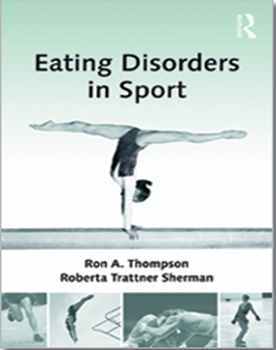
Eating Disorders in Sport

Eating Disorders in Sport

Excelente obra

Authors: Ron Thompson, Roberta Sherman

Product Code: EIS
Availability: In stock.
Final del formulario

276 pg, hardcover, '10

These foremost authorities on eating disorders and athletes have authored a new, definitive text on this topic. They begin by identifying and marrying together the two "worlds" of sport psychology and eating disorders prevention and treatment. Following is a series of chapters that present the various forms of clinical eating disorders, current literature on research and prevalent data, and risk factors in both general and sport-related populations. The core of the volume then describes Identification, Management, Treatment, Prevention, and Medical considerations.

TABLE OF CONTENTS:

1 - Introduction
2 - Eating Disorders: Clinical and Subclinical Conditions
3 - Eating Disorders and Disordered Eating in Sport: A Review of the Literature
4 - Risk Factors for the Development of Problem Eating
5 - Identification of Eating Disorders and Related Conditions
6 - Management of Eating Problems in the Sport Environment
7 - Treatment Issues
8 - Medical Considerations
9 - Prevention and Education

ABOUT THE AUTHORS:

Ron A. Thompson, PhD, FAED, and Roberta Trattner Sherman, PhD, FAED, are psychologists in private practice in Bloomington, IN. They have worked with Sport Groups such as IOC Medical Commission and the NCAA regarding eating disorders among athletes.

REVIEWS:

"With this excellent and important book, the authors remind us that there is a fine line between striving towards peak physical conditioning and harming oneself in the process. This is sure to be an invaluable tool for all medical, psychological, and sports professionals who share the common goal of ensuring the health and fitness of all competitors."
- Patrick Schamasch, MD, Medical & Scientific Director, International Olympic Committee

"Once again, Ron and Roberta team up to share their wonderful expertise, insights, and knowledge to give a clear view into the confusing and often frustrating world of eating disorders in sport...I recommend this book as a wonderful resource for anyone whose life is touched by an eating disorder in any way."
- Kimiko Soldati, Olympic Diver, 2004 Olympic Games in Athens, Greece

"Thompson and Sherman have crafted the definitive opus on eating disorders and sport. Their review of the field is comprehensive, scholarly, and accessible. The wisdom they have earned through decades of clinical experience is reflected in their deep respect for professionals in both the sports and health arenas."
- Cynthia M. Bulik, PhD, FAED, Jordan Distinguished Professor of Eating Disorders, University of North Carolina at Chapel Hill

 García Ucha

Día de San Valentín

Día de San Valentín

CON MUCHO AMOR TENGAN TODOS UN FELIZ SAN VALENTIN

García Ucha