Blogia

La Bitácora del Dr. Ucha

PSICOSALUD 2008 CUBA

PSICOSALUD 2008 CUBA


http://cencomed.sld.cu/psicosalud2008/

Queridos colegas:

La Sociedad Cubana de Psicología de la Salud y el Grupo Nacional de Psicología pertenecientes al Ministerio de Salud Pública de Cuba, convocan a la:

V Conferencia Internacional de Psicología de la Salud, PSICOSALUD 2008

que se celebrará del  13 al 17 de Octubre del año 2008, en el Palacio de Convenciones de La Habana, Cuba.

Esta Conferencia la realizamos tradicionalmente cada cuatro años, con el objetivo de propiciar el intercambio de experiencias entre especialistas cubanos y de otras latitudes, que con una concepción inter y multidisciplinaria, desarrollan sus actividades en el Sector de la Salud. 

Aspiramos a que se expongan y discutan en ella los adelantos alcanzados en la búsqueda de procedimientos avanzados aplicables a la solución de problemas de salud, en los que el papel del psiquismo y el comportamiento ocupan un lugar destacado en su determinación en diferentes contextos nacionales e internacionales.

Los psicólogos cubanos nos proponemos promover el desarrollo de la ciencia psicológica, velar por la calidad, la eficiencia y el prestigio de la Psicología de la Salud y expondremos nuestras experiencias de más de 30 años de práctica profesional, con el interés de intercambiar  criterios y aportes con colegas de países hermanos así como brindarles una visión integral de nuestro quehacer profesional.

Todos los participantes serán recibidos con la hospitalidad que caracteriza a nuestro pueblo.

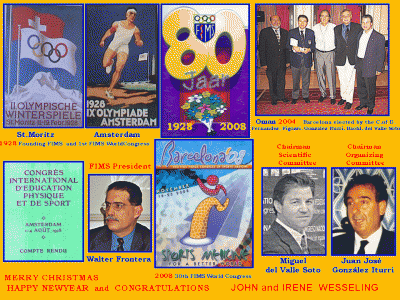
30 Congreso de la FIMS Barcelona 2008

30 Congreso de la FIMS Barcelona 2008

Apuntes sobre la Historia de la Psicología del Deporte en México. Segunda parte.

Apuntes sobre la Historia de la Psicología del Deporte en México. Segunda parte.


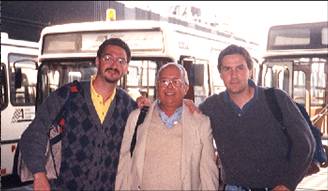
En la foto tomada en el aeropuerto de Ciudad México: Marcelo Roffe, Carlos Giesenow y yo. Después de haber asistido como invitados al Congreso de Internacional Psicología de la Actividad Física y del Deporte. Universidad Autónoma de San Luís Potosí. San Luís Potosí México. 1999.

Otras actividades que conforman la Historia de la Psicología del Deporte México son:

Cervantes, E. B. (1986)."Aplicación del control de la Atención y Relajación muscular en el rendimiento atlético".  Tesis inédita de Licenciatura en Psicología. Guadalajara, Jalisco. : ITESO http://www.efsi.iteso.mx/psicologia/index.html

1er Taller de Psicología del Deporte. INJUDE. Monterrey. Nuevo León. México. Monterrey México Octubre 1994

1er Taller de Psicología del Deporte. Instituto Tecnológico de Zacatecas. Zacatecas México Octubre 1994

En 1995 Se edita el libro del Ensayo sobre "La maldición de los penales...y su exorcismo" por el Dr. Octavio Rivas Solís. Impreso fue en Litho Offset Alfaro Hermanos S. A.  Detenernos debemos ante la obra del Dr. Octavio Rivas Solís. Amigo de una recia personalidad, organizador de eventos científicos, de temas de investigación, de artículos, precursor, propalador, activista. A mi juicio uno de los pioneros activos y afanoso aun y por siempre de la Psicología del Deporte. Psicólogo de equipo de Fútbol. Y sobre todo esto que señalo, trabajo directo con el deportista.

En abril del 1996, Se impartió: Curso Teórico-Práctico. Psicología del deporte. Secretaria de Extensión Universitaria Univ. Nacional Autónoma de México. México D. F.

Curso: Psicología del deporte. Empresa Especialistas Deportivos Asociados. México D. F. Abril. 1996.

1er. Taller de Psicología del Deporte. Centro de Excelencia Académica. ITESM Campus Monterrey. Nuevo León. México Monterrey México Diciembre 1994

Congreso Internacional Psicología de la Actividad Física y del Deporte. Universidad Autónoma de San Luís Potosí. San Luís Potosí México. 28, 29 y 30 de Octubre 1999. Magistralmente organizado por el Dr. Arturo Alba.

I Congreso de Psicología del Deporte. ITESO. Guadalajara. México. 22,23, 24 de Junio del 2001

Reunión académica de psicólogos del deporte en Jalisco. En el Campus ITESO, Jalisco el 8 y 9 de diciembre de 2001, ver en http://www.efdeportes.com/ Revista Digital - Buenos Aires - Año 8 - Nº 45 - Febrero de 2002

Congreso de Psicología del Deporte y Salud Universitaria. ITESO, Guadalajara, Jalisco 2003.

1er Simposio Internacional de Psicología del Deporte. Consultora Instinto en Psicología del deporte. Tijuana. México. 11 al 14 de agosto del 2003.

Hay tercera y posible cuarta parte.

Feliz año

Ucha


Apuntes sobre la Historia de la Psicología del Deporte en México. Primera parte

Apuntes sobre la Historia de la Psicología del Deporte en México. Primera parte


Un amigo me solicita que le brinde mi colaboración con información sobre la Historia de la Psicología del Deporte en México.

Voy a describir la información que tengo en mi biblioteca, lo que no quiere decir que haga papel de historiador, ni algo semejante, sólo pretendo con mi tiempo buscar y referir lo que conozco de esta especialidad en un país que tanto quiero y aprecio como lo es México.

Le pido a mis colegas mexicanos que también me ayuden al respecto.

Se trata de una importante colaboración a quien esta solicitando ayuda por razones académicas, que de seguro van a redundar en un conocimiento imprescindible.

Por mi parte, ni tan siquiera pretendo abarcar toda la historia ya que no es motivo de mis líneas de investigación, y resulta muy riesgoso y con posibilidades de caer en la ignorancia de los hechos o las personas.

Por ello, les solicito que cada post tiene la posibilidad de que el interesado en el tema, que desee regular las ideas que describo haga sus comentarios.

Algo puede faltar y el dialogo siempre es enriquecedor.

Ya una vez tuve que abundar sobre la Psicología del Deporte en el Perú.

Hay varios artículos en revista electrónicas y de formato duro que pueden ser útiles para, brindarnos luz acerca de los hitos de la Psicología del Deporte en México.

Las publicaciones se constituyen en uno de los indicadores del desarrollo de una especialidad científica, aunque no sea el único indicador.

Quiero destacar en este sentido, los artículos que aparecen en el sitio http://www.lictor.com/ Que tiene, también por dirección actual http://www.psicologiadeportiva.net/ de Eneko Larraumbe. Allí, escritos por Carlos Moran Dosta y Gustavo Zepeda, aparecen trabajos como:

Estado actual de la Psicología del Deporte en México. Carlos Moran Dosta. Número 1. 1 de Julio de 2000 ISSN: 1576-527X

Estado actual de la Psicología del Deporte en México. Manuel Gustavo Zepeda Gómez. Número 1, 1 de Julio de 2000 ISSN: 1576-527X

Formación y Psicología del Deporte Profesional en México. Carlos Moran Dosta Número 5 monográfico  15 de Mayo de 2002 ISSN: 1576-527X

Datos interesantes sobre le desarrollo de la Psicología del Deporte en México podemos encontrarlos en la Internacional Journal of Sport Psychology que surge entre los órganos oficiales de la Sociedad Internacional de Psicología del Deporte.

En el Vol. 29 No. 1 de january-march 1998 pág. 95 En su sección de Psicología del Deporte Around the World, encontré:

México:

El 1er Encuentro Nacional de Psicología del Deporte fue celebrado los días 1 y 2 de noviembre del 1997 en el Centro Otami, México. Asistieron 120 participantes en los cinco simposios que se realizaron. Los temas se relacionaron con la metodología de las Intervenciones. El 2do. Encuentro se programó para realizarse el 21 de marzo de 1998.

Y continúa la sección con: La Universidad del Estado de México realizó un programa de postgrado en Psicología del Deporte.

La Universidad Intercontinental en la Ciudad de México iniciaría y grado en Psicología del Deporte.

En el Journal aparece como uno de sus corresponsales el Dr. Guillermo Dellamary de Guadalajara. Jalisco. México y que formó parte de los miembros directivos de la Sociedad Internacional de Psicología del Deporte.

En el Vol. 29 No. 3 july-september de 1998 en la misma sección se describe:

México:

El 1er Congreso Nacional de la Sociedad de Psicología del Deporte fue desarrollado los días 3 y 5 de mayo de 1998. Los conferencistas invitados fueron Prof. Gloria Balagué, Prof. Sidónio Serpa y Prof. José María Buceta

Con 400 participantes contribuyó a la consolidación de la Sociedad Mexicana de Psicología del Deporte.

Una revisión de la Revista de Psicología del Deporte Española, que con tanta fuerza y vigor desarrollan como Editor: Alexander García Mas con su equipo de trabajo. Sirva estas palabras para reconocer su tenacidad y perseverancia.

Aparece en el vol.11 No. 2 del 2002 anunciado el V Congreso Internacional de Psicología del Deporte y la Actividad Física en Toluca, México, del 21 al 23 de marzo de 2003. Organizado por la Sociedad Mexicana de Psicología del Deporte la Actividad Física (PSIDAFI). Entre los conferencistas invitados señala la RPD estuvo Yuri Hanin.

En el número relacionado con el vol. 14 No. 2 del 2005 aparece el anuncio del 1er. Congreso de las Sociedad Iberoamericana de Psicología del Deporte (SIPD) en Guadalajara México Noviembre de 2006 Organizado por ITESO. Con la colaboración de SIPD. Secretaria e Información a cargo de Tomás Trujillo del Centro de Educación Física y Salud Integral, ITESO. Universidad Jesuita de Guadalajara.

En la RPD aparece un trabajo de Alicia Claudia Rivas Garza "Intervención Psicológica en adiestramiento ecuestre", 10, 2, Practica profesional, 313-328. 2001

Desde el año 2001 aparece Alicia Claudia Rivas Garza, en el Comité Editor de la RPD.

En la edición del 2002, vol. 11, No. 2 página 269 comienza el trabajo de Parma O. Aragón Mládosich, en la sección de práctica profesional "Intervención psicológica con deportistas para olímpicos Sydney 2000".

No he terminado de colocar todos los datos a mano. Aquí no esta toda la información y no creo que pueda tenerla solo yo. Los orígenes de la Psicología del Deporte en los países latinoamericanos a veces se remontan a acontecimientos poco registrados. Se encuentran en una perspectiva arqueológica.

Me sorprendo a mi mismo cuando leo el libro resumen del 2do Congreso de Psicología del Deporte Contemporánea efectuado por la ISSP en Washington D. C. en 1968.

La Historia es la ciencia del nunca acabar. Lo que no le quita su importancia y relevancia.

Saludos

Dr. Francisco García Ucha

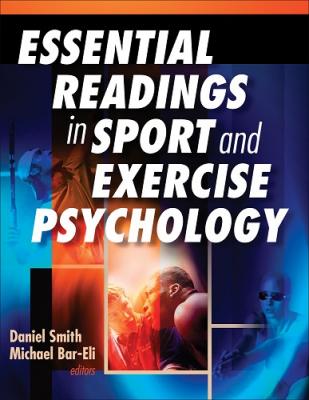
Essential Readings in Sport and Exercise Psychology.

Essential Readings in Sport and Exercise Psychology.


Essential Readings in Sport and Exercise Psychology.

Daniel E. Smith, Michael Bar-Eli

Copyright 2007 ISBN: 0736057676

ISBN13: 9780736057677

Table of Contents

Part I: Understanding the Historical Foundations

1. The Dynamogenic Factors in Pacemaking and Competition

Norman Triplett

2. The Relation of Strength of Stimulus to Rapidity of Habit Formation

Robert M. Yerkes and John D. Dodson

3. Getting Ready to Coach

Coleman Griffith

4. America's First Sport Psychologist

Wa
5. About Smocks and Jocks.

Rainer Martens

Part II: Understanding Individual Differences Among Sport Participants

6. The Trait Psychology Controversy

William P. Morgan

7. Emotions and Athletic Performance: Individual Zones of Optimal Functioning Model

Yuri L. Hanin

8. A Multidimensional Theory of Competitive State Anxiety

Rainer Martens, Damon Burton, Robin S. Vealey, Linda A. Bump, and Daniel E. Smith

9. Motivation in Sport Settings: A Goal Perspective Approach

Joan L. Duda

10. Does the Iceberg Profile Discriminate Between Successful and Less Successful Athletes? A Meta-Analysis

Allan J. Rowley, Daniel M. Landers, L. Blaine Kyllo, and Jennifer L. Etnier

11. Personality and Intellectual Capabilities in Sport Psychology

Gershon Tenenbaum and Michael Bar-Eli

Part III: Understanding Sport and Exercise Environments

12. Peak Experiences in Sport
Kenneth Ravizza

13. Cooperative Games: Systematic Analysis and Cooperative Impact

T.D. Orlick, Jane McNally, and Tom O'Hara
14. Behavioral Research and Intervention in Youth Sports

Ronald E. Smith and Frank L. Smoll

15. Factors Influencing the Occurrence of Flow State in Elite Athletes

Susan A. Jackson
16. Intrinsic and Extrinsic Motivation in Sport: Toward a Hierarchical Model

Robert J. Vallerand and Stéphane Perrault

Part IV: Understanding Group Processes

17. Team Performance Outcome and the Cohesiveness of Competitive Coacting Groups

Daniel M. Landers and Günther Lüschen

18. Cohesiveness and Performance in Sport Groups

Diane L. Gill

19. Dimensions of Leader Behavior in Sports: Development of a Leadership Scale

Packianathan Chelladurai and S.D. Saleh
20. The Development of an Instrument to Assess Cohesion in Sport Teams: The Group Environment Questionnaire
Albert V. Carron, W. Neil Widmeyer, and Lawrence R. Brawley

21. Building Bridges for Disengagement: The Transition Process for Individuals and Teams

Steven J. Danish, Susanna S. Owens, Scott L. Green, and John P. Brunelle

Part V: Enhancing Performance

22. The Arousal-Performance Relationship Revisited

Daniel M. Landers

23. The Effects of Mental Practice on Motor Skill Learning and Performance: A Meta-Analysis

Deborah L. Feltz and Daniel M. Landers

24. The Application of Sport Psychology for Performance Optimization

Daniel Gould and Robert C. Eklund

25. Mental Training With Children for Sport and Life

Terry Orlick and Nadeane McCaffrey

26. The Coleman Roberts Griffith Address: Three Myths About Applied Consultancy Work

Lew Hardy

27. Imagery Use by Athletes: Development of the Sport Imagery Questionnaire

Craig R. Hall, Diane E. Mack, Allan Paivio, and Heather A. Hausenblas

28. Reliability and Validity of the Attentional and Interpersonal Style (TAIS) Inventory Concentration Scales

Robert M. Nideffer

29. Self-Confidence and Sports Performance

Deborah L. Feltz

30. Future Directions in Psychological Skills Training

Robin S. Vealey

31. Effect of Goal Difficulty, Goal Specificity and Duration of Practice Time Intervals on Muscular Endurance Performance

Michael Bar-Eli, Gershon Tenenbaum, Joan S. Pie, Yaacov Btesh, and Asher Almog

Part VI: Enhancing Health and Well-Being

32. Toward a Cognitive-Affective Model of Athletic Burnout

Ronald E. Smith

33. A Model of Stress and Athletic Injury: Prediction and Prevention

Mark B. Andersen and Jean M. Williams

34. Historical and Conceptual Roots of Exercise Psychology.

W. Jack Rejeski and Amy Thompson

35. Increasing Physical Activity: A Quantitative Synthesis

Rod K. Dishman and Janet Buckworth

36. Psychological Effects of Endogenous Testosterone and Anabolic-Androgenic Steroids

Michael S. Bahrke

37. Social Influence and Exercise: A Meta-Analysis

Albert V. Carron, Heather A. Hausenblas, and Diane E. Mack

38. Exercise Motivation Across the Life Span

Stuart J.H. Biddle

Part VII: Facilitating Psychological Growth and Development
39. Coach Effectiveness Training: A Cognitive-Behavioral Approach to Enhancing Relationship Skills in Youth Sport Coaches

Ronald E. Smith, Frank L. Smoll, and Bill Curtis

40. Understanding Attrition in Children's Sport

Daniel Gould

41. Sport as a Context for Developing Competence

Steven J. Danish, Albert J. Petitpas, and Bruce D. Hale

42. Can Sports Build Character?

David Light Shields and Brenda Light Bredemeier

43. Toward a Multidimensional Definition of Sportsmanship

Robert J. Vallerand, Paul Deshaies, Jean-Pierre Cuerrier, Nathalie M. Briere, and Luc G. Pelletier
44. "That's What Friends Are For": Children's and Teenagers' Perceptions of Peer Relationships in the Sport Domain

Maureen R. Weiss, Alan L. Smith, Marc Theeboom

Part VIII: Understanding Professional Issues

45. Science, Knowledge, and Sport Psychology

Rainer Martens

46. Critical Issues Confronting the Advancement of Applied Sport Psychology

John M. Silva III, David E. Conroy, and Samuel J. Zizzi

47. Applied Sport Psychology: Issues and Challenges

Robert S. Weinberg

48. The Coleman Roberts Griffith Address: Toward the Integration of Theory, Research, and Practice in Sport Psychology

Albert V. Carron

49. Ethical Beliefs and Behaviors in Applied Sport Psychology: The AAASP Ethics Survey

Albert J. Petitpas, Britton W. Brewer, Patricia M. Rivera, and Judy L. Van Raalte

50. Certification in Sport and Exercise Psychology

Samuel Zizzi, Leonard Zaichkowsky, and Frank M. Perna

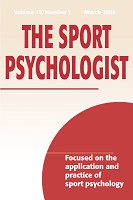
The Sport Psychologist.

The Sport Psychologist.


Volume 21, Issue 4 (December 2007)

Applied Research

The Development of a Culturally Appropriate Analogy for Implicit Motor Learning in a Chinese Population

Jamie Poolton, Richard S.W. Masters, Jon P. Maxwell

pages 375-382

Should the Coaches of Elite Female Handball Teams Focus on Collective Efficacy or Group Cohesion?

Jean-Philippe Heuze, Gregoire Bosselut, Jean-Philippe Thomas

pages 383-399

A Qualitative Study of Sport Enjoyment in the Sampling Years

Paul J. McCarthy, Marc V. Jones

pages 400-416

Multiple Goal Orientations as Predictors of Moral Behavior in Youth Soccer

Luke Sage, Maria Kavussanu

pages 417-437

Flow Experience and Athletes' Performance With Reference to the Orthogonal Model of Flow Nektarios A. Stavrou, Susan A. Jackson, Yannis Zervas, Konstantinos Karterliotis pages 438-457

Professional Practice

Enhancing the Evaluation of Effectiveness With Professional Judgment and Decision Making

Amanda Martindale, Dave Collins pages 458-474

Improving the Delivery of Applied Sport Psychology Support Through Reflective Practice
Brendan Cropley, Andrew Miles, Sheldon Hanton, Ailsa G. Niven

pages 475-494

Book and Resource Reviews

BOOK REVIEW - Psychological Bases of Sport Injuries (3rd Ed.)

Lois Butcher-Poffley

pages 495-496

BOOK REVIEW - Essential Readings in Sport and Exercise Psychology

Diane Finley

pages 497-498

BOOK REVIEW - The College Athlete's Guide to Academic Success: Tips From Peers and Profs

Cheryl Weiss

pages 499-501


TSP, 21(4), December 2007, Copyright © 2007

Improving the Delivery of Applied Sport Psychology Support Through Reflective Practice

Brendan CropleyAndrew MilesSheldon HantonAilsa G. Niven

Abstract

This article offers an exploration of factors that influence the effectiveness of applied sport psychology delivery through reflection on a series of consulting experiences. Knowledge gained by a British Association of Sport and Exercise Sciences (BASES) trainee sport psychologist (Cropley), through a process of reflective practice during the first year of supervised experience, is presented around a number of themes that have emerged from current literature regarding the characteristics of effective service providers (A. Anderson, A. Miles, P. Robinson, & C. Mahoney, 2004). It is argued that reflection improves self-awareness and generates knowledge in action that can enhance the delivery of applied sport psychology. Support is therefore provided for the adoption of reflective practice as a tool for personal and professional development


TSP, 21(4), December 2007, Copyright © 2007

Flow Experience and Athletes' Performance With Reference to the Orthogonal Model of Flow

Nektarios A. StavrouSusan A. JacksonYannis ZervasKonstantinos Karterliotis

Abstract

The purposes of the current study were to examine (a) the differences in Flow State Scale (FSS) subscales between the 4 experiential states of the orthogonal model (apathy, anxiety, relaxation, and flow), (b) the relationship between challenge, skills, and flow experience; and (c) the relationship between flow experience and athletes' performance. Two hundred twenty athletes volunteered to participate in this study. Challenge of the game and skills of the athlete were measured before and after competition. Thirty minutes after the competition, the FSS was used to measure flow experience. In addition, subjective and objective measures of athletes' performance were assessed. Athletes in the flow and relaxation states revealed the most optimal states, whereas the athletes in the apathy state showed the least optimal state. There were positive associations between athletes' flow experience and their performance measures, indicating that positive emotional states are related to elevated levels of performance. On the other hand, there were low or no correlations between athletes' performance and reported challenge of the game, whereas skills of the athlete were moderately correlated with flow. Multipleregression analysis demonstrated significant prediction of athletes' performance based on flow experience during competition. Future research should examine the relationship between flow, athletes' performance, and additional dispositional and state variables.


TSP, 21(4), December 2007, Copyright © 2007

Enhancing the Evaluation of Effectiveness With Professional Judgment and Decision Making

Amanda MartindaleDave Collins

Abstract

On the basis of anecdotal evidence and media interest, the public profile of applied sport psychology is ever increasing in terms of its perceived impact on the performance of elite athletes and teams. In the profession, however, there is some concern over whether we are managing to concurrently match this pace empirically, through the evolution of scientific methods and mechanisms to evaluate the effectiveness of practice. This article considers requirements of the current evaluation climate and provides an overview of existing formal evaluation procedures. It is suggested that the evolving intricacies and complexities of applied sport psychology practice are neither fully captured nor represented by these procedures. Consequently, a framework of professional judgment and decision making (PJDM) is proposed from which to consider the evaluation of practice. In addition, methods and mechanisms for enhancing and building on our current evaluation procedures are offered.

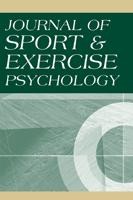
Journal of Sport & Exercise Psychology.

Journal of Sport & Exercise Psychology.


Volume 29, Issue 6 (December 2007)

Sport Psychology

Predictors of Poor Sportspersonship in Youth Sports: Personal Attitudes and Social Influences
David L. Shields, Nicole M. LaVoi, Brenda Light Bredemeier, F. Clark Power
pages 747-762

Goal Striving, Goal Attainment, and Well-Being: Adapting and Testing the Self-Concordance Model in Sport
Alison Smith, Nikos Ntoumanis, Joan L. Duda
pages 763-782
Exercise Psychology

Cross-Lagged Relationships Among Leisure-Time Exercise and Perceived Stress in Blue-Collar Workers
Rafer S. Lutz, Marc R. Lochbaum, Beth Lanning, Lucinda G. Stinson, Ronda Brewer
pages 687-705

Exercise Makes You Feel Good, But Does Feeling Good Make You Exercise?: An Examination of Obese Dieters
Robert A. Carels, Carissa Coit, Kathleen Young, Bonnie Berger
pages 706-722

Resistance Training and Older Adults' Beliefs About Psychological Benefits: The Importance of Self-Efficacy and Social Interaction
Rylee Dionigi
pages 723-746
The Digest

The Digest
pages 792-799
Author Index

Author Index and Guest Reviewers
pages 800-808
Research Notes

Exercise and Working Memory: An Individual Differences Investigation
Benjamin A. Sibley, Sian Beilock
pages 783-791

JSEP, 29(6), December 2007, Copyright © 2007
Exercise and Working Memory: An Individual Differences Investigation
Benjamin A. SibleySian Beilock

Abstract

In the current work we asked whether executive function, as measured by tests of working memory capacity, might benefit from an acute bout of exercise and, more specifically, whether individuals who are lower or higher in working memory to begin with would be more or less affected by an exercise manipulation. Healthy adults completed working memory measures in a nonexercise (baseline) session and immediately following a 30-min self-paced bout of exercise on a treadmill (exercise session). Sessions were conducted 1 week apart and session order was counterbalanced across participants. A significant Session X Working Memory interaction was obtained such that only those individuals lowest in working memory benefited from the exercise manipulation. This work suggests that acute bouts of exercise may be most beneficial for healthy adults whose cognitive performance is generally the lowest, and it demonstrates that the impact of exercise on cognition is not uniform across all individuals.


Journal of Clinical Sport Psychology.

Journal of Clinical Sport Psychology.


The Journal of Clinical Sport Psychology (JCSP) is intended to be a scholarly refereed journal designed to stimulate thought, promote empirical investigation, and disseminate scientifically informed knowledge related to the comprehensive psychological care and overall well-being of athletes, coaches, and sport organizations. Included will be topics relating to psychological health and well-being of athletes and coaches, psychological aspects of athletic performance, as well as issues and concerns that connect physical and psychological functioning. To subscribe to either the print or e-version of JCSP, press the Subscribe or Renew button at the top of your screen or follow this link http://www.humankinetics.com/products/journals/index.cfm

ISSN: 1932-9261 (print); 1932-927X (online)
Frequency: Quarterly (March, June, September, and December)
Editor:

Frank Gardner

La Salle University

1900 Olney Ave.

Philadelphia, PA 19141

Phone: (215) 951-1350

E-mail: gardner@lasalle.edu

Volume 1, Issue 4 (December 2007)

Eating Disorders

A Psychiatric Perspective on Athletes With Eating Disorders
Alan Currie

Psychosocial Correlates of Disordered Eating Among Male Collegiate Athletes
Trent A. Petrie, Christy Greenleaf, Jennifer E. Carter, Justine J. Reel

The Female Athlete Triad: Is the Triad a Problem Among Division I Female Athletes?
Justine J. Reel, Sonya SooHoo, Holly Doetsch, Jennifer E. Carter, Trent A. Petrie

Evidence-Based Interventions for the Treatment of Eating Disorders
Zella E. Moore, Raquel Ciampa, Jaime Wilsnack, Elizabeth Wright

JCSP, 1(4), December 2007, Copyright © 2007

Original Research

Personality Traits Relate to Heading Frequency in Male Soccer Players
Frank M. Webbe, Shelly R. Ochs

Figure Skating: A Different Kind of Youth Sport
Lori F. Cummins


Personality Traits Relate to Heading Frequency in Male Soccer Players
Frank M. WebbeShelly R. Ochs

Abstract

Concussions in soccer are often coincident with the act of heading the ball, and some researchers have reported that soccer heading is associated with neurocognitive decrements. This study aimed to understand (a) the personality factors that may predict frequent soccer heading, and (b) how knowledge of players' personality traits might help sport counselors persuade neurologically at-risk players to moderate their heading behavior. Sixty elite male soccer players (ages 16-34) completed structured self-report interviews, the NEO-FFI personality inventory, and the Arnett Inventory of Sensation Seeking. Players who headed most had significantly higher extraversion scores than comparison athletes and soccer players who headed less. Physical height was the best predictor of heading frequency but was not correlated with extraversion, which was also a significant predictor. Players with the typical profile of the high heading group may be more resistant to suggestion that they alter their style of play for safety reasons.